Berliner Philharmonie tickets 16 September 2026 - German Symphony Orchestra Berlin I | GoComGo.com

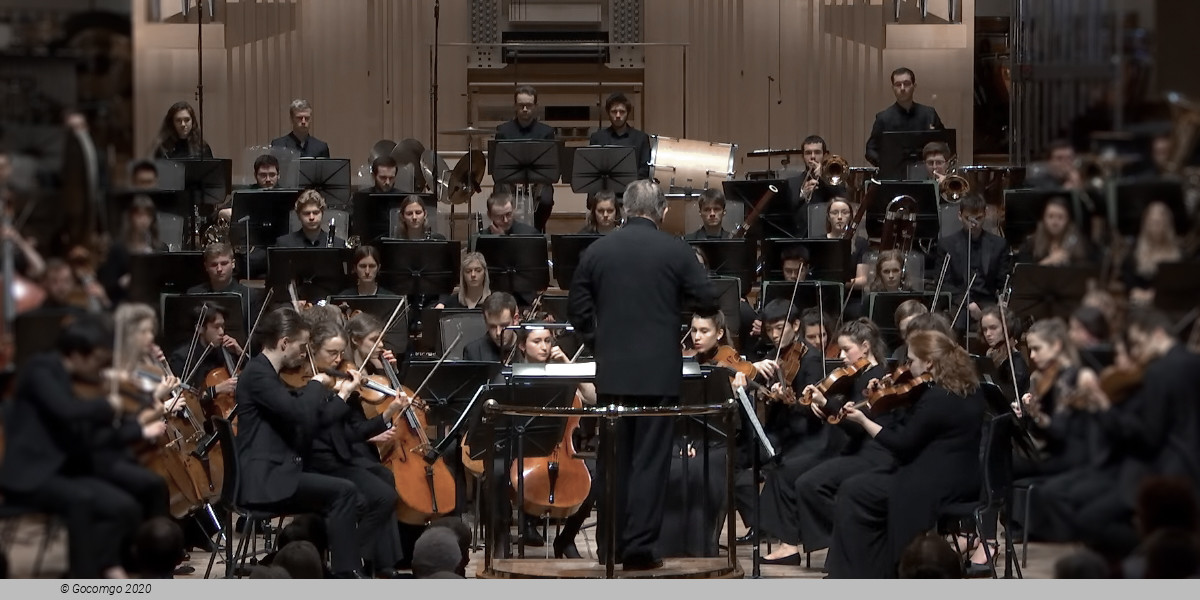
German Symphony Orchestra Berlin I

Berliner Philharmonie, Main Auditorium, Berlin, Germany
All photos (1)
Select date and time
8 PM
From
US$ 109

E-tickets: Print at home or at the box office of the event if so specified. You will find more information in your booking confirmation email.

You can only select the category, and not the exact seats.
If you order 2 or 3 tickets: your seats will be next to each other.
If you order 4 or more tickets: your seats will be next to each other, or, if this is not possible, we will provide a combination of groups of seats (at least in pairs, for example 2+2 or 2+3).

Important Info
Type: Classical Concert
City: Berlin, Germany
Starts at: 20:00

E-tickets: Print at home or at the box office of the event if so specified. You will find more information in your booking confirmation email.

You can only select the category, and not the exact seats.
If you order 2 or 3 tickets: your seats will be next to each other.
If you order 4 or more tickets: your seats will be next to each other, or, if this is not possible, we will provide a combination of groups of seats (at least in pairs, for example 2+2 or 2+3).

Programme
Benjamin Britten: Four Sea Interludes op. 33a from the opera Peter Grimes (1944/45)
Gustav Mahler: Adagio 1st movement from Symphony No. 10 (1910)
Lisa Lim: Sappho/ Bioluminescence (2019/20) for orchestra
Ludwig van Beethoven : Concerto for Piano and Orchestra in E flat major op. 73 (1808/09)
Overview

Benjamin Britten’s Sea Interludes from his hit opera Peter Grimes conclude with a violent storm. Here the tragic hero’s vision of happiness and inner peace is swept away by a final outburst from the orchestra. At the Deutsche Symphonie-Orchester Berlin’s concert conducted by Simone Young, they are followed by the Adagio from Gustav Mahler’s unfinished 10th Symphony: a “tornado of life” (Jens Malte Fischer) that was written in one of the deepest crises that the composer suffered in the last summer of his life. Oscillating layers dominate the soundscape of Sappho/ Bioluminescence by the Australian composer Liza Lim, before the evening ends with Beethoven’s Piano Concerto No. 5.

Britten dedicated his opera Peter Grimes to the “perpetual struggle of men and women whose livelihood depends on the sea”. Prior to the opera’s premiere, he compiled four of the orchestral preludes and interludes to form the Sea Interludes – a sequence of exceptionally vivid miniature tone poems evoking images of the English North Sea coast with its dramatic steep cliffs, picturesque fishing villages and raging storms. Gustav Mahler composed a storm in the soul in the famous Adagio from his 10th Symphony after having learned of the affair between his wife Alma and Walter Gropius: the music is intensely focused on the catastrophe with a glaringly dissonant nine-note chord ominously building up following the shrill sustained A on the violins (A for Alma!). This highly eloquent music was used by the British film director Ken Russell in his Mahler film from 1974 in the scene in which the famous composer’s hut bursts into flames. Shimmering string textures, iridescent wind passages and microtonal glissandos also characterise the atmospheric orchestral piece Sappho/ Bioluminescence by Liza Lim. The bipartite title references the fragmentarily surviving mysterious and timeless lyrical poetry of the Ancient Greek poetess blended with the image of an internally physical luminescence. Finally, Beethoven’s Piano Concerto No. 5 takes us back to the time of the Napoleonic Wars, unmistakeably revealing the composer’s patriotic (and subsequently anti-Napoleonic) stance. In English-speaking countries, the work is also known as “The Emperor” which prompted the musicologist Harry Goldschmidt to suggest a more apt title: “The Anti-Emperor”.

Venue Info

Berliner Philharmonie - Berlin
Location   Herbert-von-Karajan-Str. 1

The Berliner Philharmonie is a concert hall in Berlin, Germany and home to the Berlin Philharmonic Orchestra. The Philharmonie lies on the south edge of the city's Tiergarten and just west of the former Berlin Wall. The Philharmonie is on Herbert-von-Karajan-Straße, named for the orchestra's longest-serving principal conductor. The building forms part of the Kulturforum complex of cultural institutions close to Potsdamer Platz.

The Philharmonie consists of two venues, the Grand Hall (Großer Saal) with 2,440 seats and the Chamber Music Hall (Kammermusiksaal) with 1,180 seats. Though conceived together, the smaller hall was opened in the 1980s, some twenty years after the main building.

Hans Scharoun designed the building, which was constructed over the years 1960–1963. It opened on 15 October 1963 with Herbert von Karajan conducting Beethoven's 9th Symphony. It was built to replace the old Philharmonie, destroyed by British bombers on 30 January 1944, the eleventh anniversary of Hitler becoming Chancellor. The hall is a singular building, asymmetrical and tentlike, with the main concert hall in the shape of a pentagon. The height of the rows of seats increases irregularly with distance from the stage. The stage is at the centre of the hall, surrounded by seating on all sides. The so-called vineyard-style seating arrangement (with terraces rising around a central orchestral platform) was pioneered by this building, and became a model for other concert halls, including the Sydney Opera House (1973), Denver's Boettcher Concert Hall (1978), the Gewandhaus in Leipzig (1981), Walt Disney Concert Hall in Los Angeles (2003), and the Philharmonie de Paris (2014).

Jazz pianist Dave Brubeck and his quartet recorded three live performances at the hall; Dave Brubeck in Berlin (1964), Live at the Berlin Philharmonie (1970), and We're All Together Again for the First Time (1973). Miles Davis's 1969 live performance at the hall has also been released on DVD.

On 20 May 2008 a fire broke out at the hall. A quarter of the roof suffered considerable damage as firefighters cut openings to reach the flames beneath the roof. The hall interior sustained water damage but was otherwise "generally unharmed". Firefighters limited damage using foam. The cause of the fire was attributed to welding work, and no serious damage was caused either to the structure or interior of the building. Performances resumed, as scheduled, on 1 June 2008 with a concert by the San Francisco Symphony Youth Orchestra.

The main organ was built by Karl Schuke, Berlin, in 1965, and renovated in 1992, 2012 and 2016. It has four manuals and 91 stops. The pipes of the choir organs and the Tuba 16' and Tuba 8' stops are not assigned to any group and can be played from all four manuals and the pedals.

Important Info
Type: Classical Concert
City: Berlin, Germany
Starts at: 20:00
Top of page