






 Concertgebouwplein 10
The Royal Concertgebouw is a concert hall in Amsterdam, Netherlands. The Dutch term "concertgebouw" literally translates into English as "concert building". On 11 April 2013, on occasion of the building's 125th anniversary, Queen Beatrix bestowed the Royal Title "Koninklijk" upon the building, as she did previously (in 1988) to the Royal Concertgebouw Orchestra. Because of its highly regarded acoustics, the Concertgebouw is considered one of the finest concert halls in the world, along with places such as Boston's Symphony Hall and the Musikverein in Vienna.
The architect of the building was Adolf Leonard van Gendt, who was inspired by the Gewandhaus in Leipzig, built two years earlier (and destroyed in 1943).
Construction began in 1883 in a pasture that was then outside the city, in Nieuwer-Amstel, a municipality that in 1964 became Amstelveen. A total of 2,186 piles of length twelve to thirteen metres (40 to 43 ft) were sunk into the soil. The Concertgebouw was completed in late 1886, however due to the difficulties with the municipality of Nieuwer-Amstel - filling in a small canal, paving the access roads and installing street lights - the grand opening of the building was delayed.
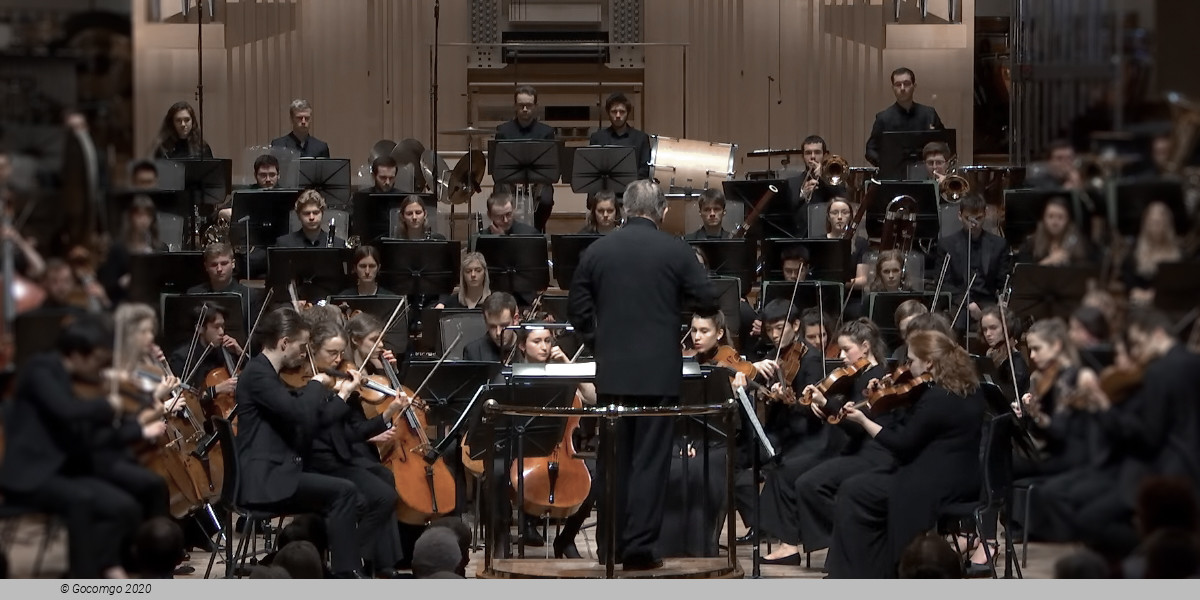
The hall opened on 11 April 1888 with an inaugural concert, in which an orchestra of 120 musicians and a chorus of 500 singers participated, performing works of Wagner, Handel, Bach, and Beethoven. The resident orchestra of the Concertgebouw is the Royal Concertgebouw Orchestra (Koninklijk Concertgebouworkest), which gave its first concert in the hall on 3 November 1888, as the Concertgebouw Orchestra (Concertgebouworkest). For many decades the Netherlands Philharmonic Orchestra and the Radio Filharmonisch Orkest have also been regular performers in the Concertgebouw.
The Main Hall (Grote Zaal) seats 1,974, and is 44 metres (144 ft) long, 28 metres (92 ft) wide, and 17 metres (56 ft) high. Its reverberation time is 2.8 seconds without audience, 2.2 seconds with, making it ideal for the late Romantic repertoire such as Mahler. Although this characteristic makes it largely unsuited for amplified music, groups such as Led Zeppelin, Pink Floyd and The Who did perform there in the 1960s. It hosts not only orchestral and operatic performances, but also jazz and world music.
A smaller, oval-shaped venue, the Recital Hall (Kleine Zaal), is located behind the Main Hall. The Recital Hall is 20 metres (66 ft) long and 15 metres (50 ft) wide. Its more intimate space is well-suited for chamber music and Lieder. The Recital Hall has 437 seats.
When the Concertgebouw was built, acoustics were something of a black art. As in shipbuilding, designers drew upon what had worked in the past without entirely understanding the underlying science. When the building was completed, the acoustics were not perfect, and a lot of effort went into fine-tuning the aural ambience. During later restorations, particular care has been taken not to alter the materials used for interior decoration with this in mind.
In 1983, the Concertgebouw was found to be sinking into the damp Amsterdam earth, with several inch-wide cracks appearing in the walls, so the hall embarked on extensive fundraising for renovations. Its difficult emergency restoration started in 1985, during which the 2,186 rotting wooden pilings were replaced with concrete pillars. Pi de Bruijn, Dutch architect designed a modern annex for a new entrance and a basement to replace cramped dressing and rehearsal space.
Today, some nine hundred concerts and other events per year take place in the Concertgebouw, for a public of over 700,000, making it one of the most-visited concert halls in the world.
As of February 2014, the managing director of the Concertgebouw is Simon Reinink and the artistic director is Anneke Hogenstijn.
The organ was built in 1890 by the organ builder Michael Maarschalkerweerd from Utrecht, and was renovated in the years 1990 to 1993 by the organ builder Flentrop. It has 60 registers on three divisions and pedal.