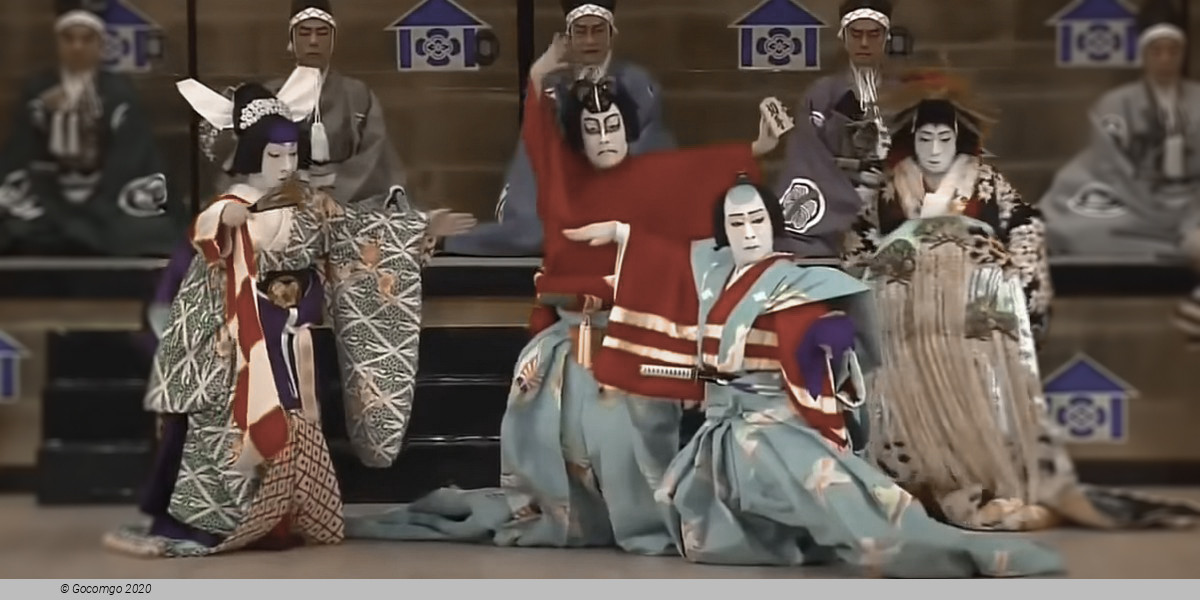
The December Program at the Kabukiza is divided into 3 parts so that one can enjoy kabuki in a more casual and accessible way.
In Part 1, the latest installment of Cho Kabuki, a collaborative production between the virtual singer Hatsune Miku and traditional kabuki, will be performed, commemorating its 10th anniversary. Please look forward to the work in which 400 years of history fuse with modern technology.
In Part 2, you will see a history play adapted from a Kōdan story concerning a man who plotted to overthrow the shogunate, as well as a sentimental tale filled with laughter and tears adapted from a popular Rakugo story portraying conjugal affection in Edo.
In Part 3, you will see a popular domestic play depicting the separation and reunion of a beautiful couple, as well as a kabuki play that was first performed in August this year to great critical acclaim, which is based on a world-famous legend.
Part 1: 11:00 AM
Cho Kabuki Powered by IOWN
SEKAI NO HANA MUSUBU KOTONOHA
['Words connecting Flowers in the World']
STORY :
After the Jōhei and Tengyō Rebellion (935-941), the thief Kidōmaru encounters the ghost of Fujiwara no Sumitomo and learns that he is Sumitomo's son Motozumi. Those who side with him are monsters, such as the high priest Chiun and the hag Ibaraki. Having seen from the shadows, Hakamadare no Yasusuke takes away a scroll in which techniques used for destroying monsters are written, and goes away.
The Minamoto brothers Yorimitsu and Yorinobu see female dancers perform at the feast in Shinsen'en and Yorimitsu falls in love with the dancer with green hair. She is, in reality, Nanaayadayū from the Kujō pleasure quarters, so he visits that place to see her.
At the same time, Kidōmaru breaks into the treasury of the Imperial Palace and steals the arrows Suiha and Hyōha. Yorinobu stands in Kidōmaru's way, but is defeated again. In the presence of the dying Yorinobu, his fiancée Princess Hatsune appears. Yorinobu tells her the situation and breathes his last, but Princess Hatsune is, in reality, … In the meantime, Hakamadare, with Rashōmon as his base of operation, encounters Lady Sayokaze, the wife of Watanabe no Tsuna, and acts sympathetically.
As the season proceeds, Yorimitsu becomes infatuated with Nanaayadayū and continues to frequent the pleasure quarters. His loyal retainer Hirai Yasumasa comes to remonstrate with him. As Yorimitsu is angry about Yasumasa's behaviour, the proprietress of the Izumiya mediates between them. Nanaayadayū is, in reality, Masakado's daughter Princess Nanaaya, and Hakamadare and the high priest Chiun act in unexpected ways.
What will become of Yorimitsu, his retainer and Hakamadare, as well as Princess Nanaaya and Kidōmaru who go against them?
Commemorating the 10th anniversary of Cho Kabuki, we have retained ideas and direction from previous works to make up a new story. Please enjoy a masterpiece characteristic of Cho Kabuki, in which stylish beauty and the charms of Kabuki fuse with the latest technology, such as the shadow cloning technique using technology by NTT.
Part 2: 02:45 PM
MARUBASHI CHŪYA
['Marubashi Chūya']
STORY :
This is a classic play by Kawatake Mokuami written in the Meiji Period after the ban on kabuki depicting historical events had been lifted. This is the story of Marubashi Chūya, who plotted to overthrow the Edo government. He approaches Edo Castle pretending to be drunk, but has actually come to measure the depth of the moat. Unfortunately, he is observed by the Lord of Izu, one of the top officials of the shogunate. Later, Chūya has a dispute with his wife's father that eventually leads to the failure of his revolt.
SHIBAHAMA NO KAWAZAIFU
['The Leather Purse of Shibahama']
STORY :
This is a play adapted from a Rakugo story. A man who is a good-for-nothing drunkard picks up a leather purse full of coins while out fishing. He happily takes it home and celebrates by holding a big drinking party. The next morning, he asks for his purse, but his wife insists that it was all a dream. Feeling ashamed of himself, he changes his attitude and starts working hard. Three years later when the couple is living comfortably, the wife admits that she must apologize for something...
Part 3: 06:10 PM
YOWA NASAKE UKINA NO YOKOGUSHI
Genjidana
['Scar faced Yosaburō']
STORY :
At the seaside, Yosaburō, the spoilt son of a wealthy family, meets Otomi, the mistress of a gang boss, and falls in love with her at first sight. The affair is soon found out by the gang boss and Yosaburō gets beaten up, suffering wounds all over his body. Thinking that Yosaburō died, Otomi throws herself into the sea. 3 years later, Yosaburō, who has become a petty thief, and his mentor Yasu, nicknamed 'the Bat', go to blackmail the mistress of a wealthy merchant, only to discover that it is Otomi, who also survived. In one of the most famous scenes in kabuki, Yosaburō pours out his resentment against Otomi and bemoans the fate that has destroyed his life. Then Otomi learns the secret about her situation...
HI NO TORI
['The Firebird']
STORY :
In the land ruled by the Great King, there has been endless bloodshed as he has expanded his territory through repeated invasions of many nations. Now aged and suffering from illness, the Great King seeks to possess the Firebird, a bird of eternal power, in hopes of gaining everlasting life. The two princes, Yamahiko and Umihiko, are ordered to capture the Firebird, and they embark on a journey to a distant land where the Firebird has been said to dwell since ancient times. In a garden where mysterious, shining golden apple trees grow thick, the two brothers encounter a figure who introduces himself as Iwagane… Hi no Tori (The Firebird), a story that has inspired ballet and manga, now comes to life as a brand-new Kabuki production. Please look forward to a grand and mystical world unfolding before your eyes.
A kabuki program is usually made up of several different plays and dances, but at the Kabukiza Theatre, 'Single Act Seats' are available so that you can watch just one of the acts.
Tickets are sold separately for each performance. They are valid only for the performance starting at the listed time.
Single Act Tickets will be sold on the day of the performance (they cannot be reserved or purchased in advance).
Tea will not be offered at the Box Seats. Please refrain from eating at seats as well.









 4 Chome-12-15 Ginza, Chuo City